#52 · Oct 23–27 · Frost Descent
The first frost arrives
霜始降
Shimo hajimete furu · The first frost arrives
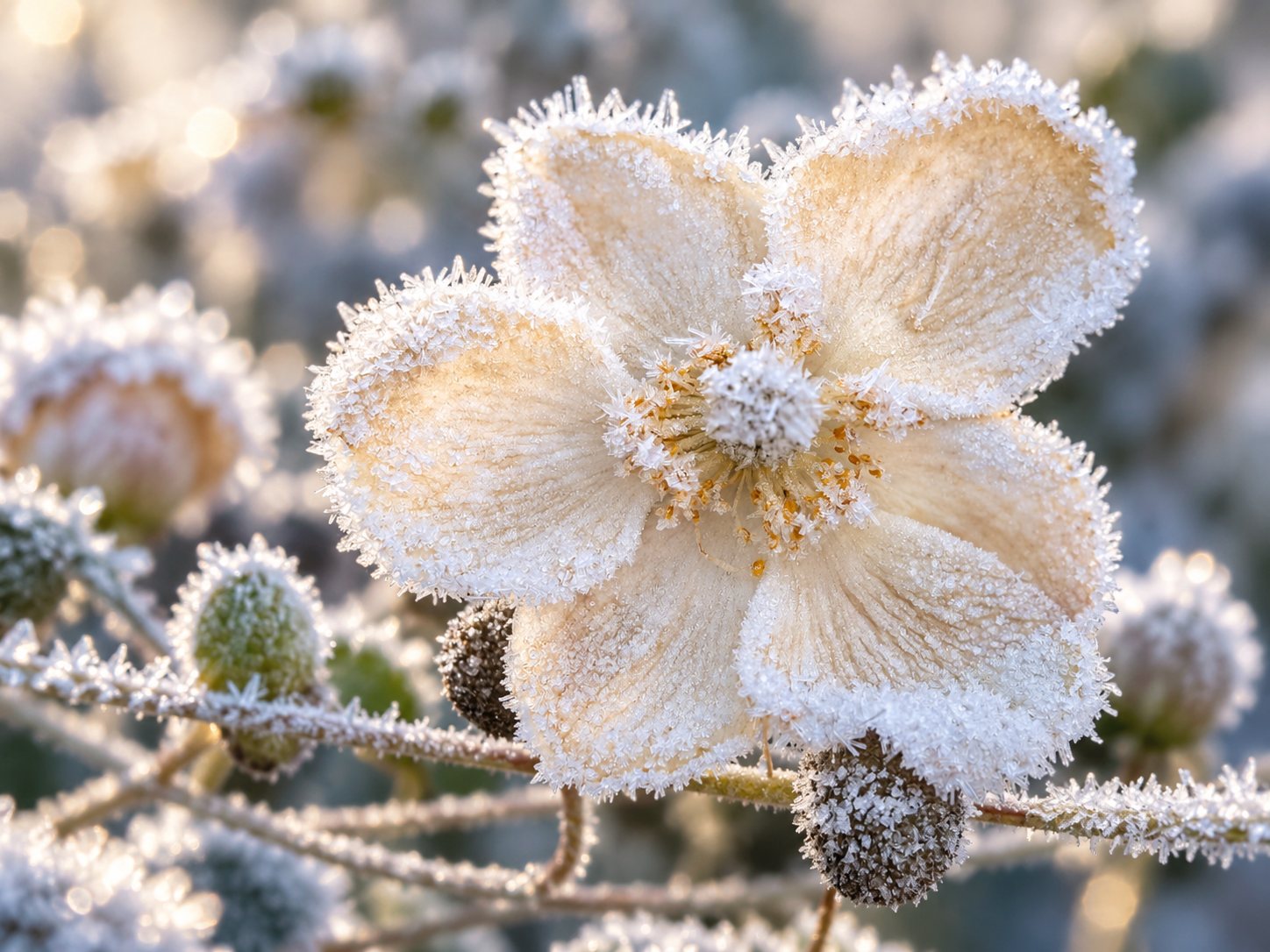
Near Schloss Elmau, frost traces the edge of a still-open flower. Winter does not arrive everywhere at once.
The season
霜始降 · Shimo hajimete furu
The first frost arrives.
Season 52 belongs to Sōkō — Frost Descent.
Its observation is almost literal: the first frost begins to appear.
But frost rarely transforms an entire landscape at once. It starts selectively — along an exposed edge, across a meadow, on a wire, a leaf or the surface of a flower.
Water that was invisible in the air during the night becomes crystalline by morning.
That small transformation is enough.
Around Schloss Elmau, the mountains may already carry snow, but this kō asks for something more precise. It asks us to notice where the cold first settles close enough to touch.
October 23–27 · Sōkō · Frost Descent
Field note · Schloss Elmau
Bavarian Alps · Autumn
Around Schloss Elmau, cold can be read at several scales.
From a distance, the first clue is obvious. Snow gathers high on the mountain faces while the forest below remains dark green. Autumn and winter occupy the same view.
Closer to the valley floor, the change becomes quieter.
The meadow around Schloss Elmau turns pale. Trees remain standing between seasons. Warm light reaches parts of the landscape while other areas stay in blue morning shadow.
And then there are the smallest surfaces.
Frost gathers along an exposed wire in a line of tiny crystals. Something that would normally disappear into the landscape suddenly becomes visible because the temperature has changed.
That shift in scale became important for Season 52.
The mountains tell me that winter is coming.
The frost tells me exactly where it has arrived.
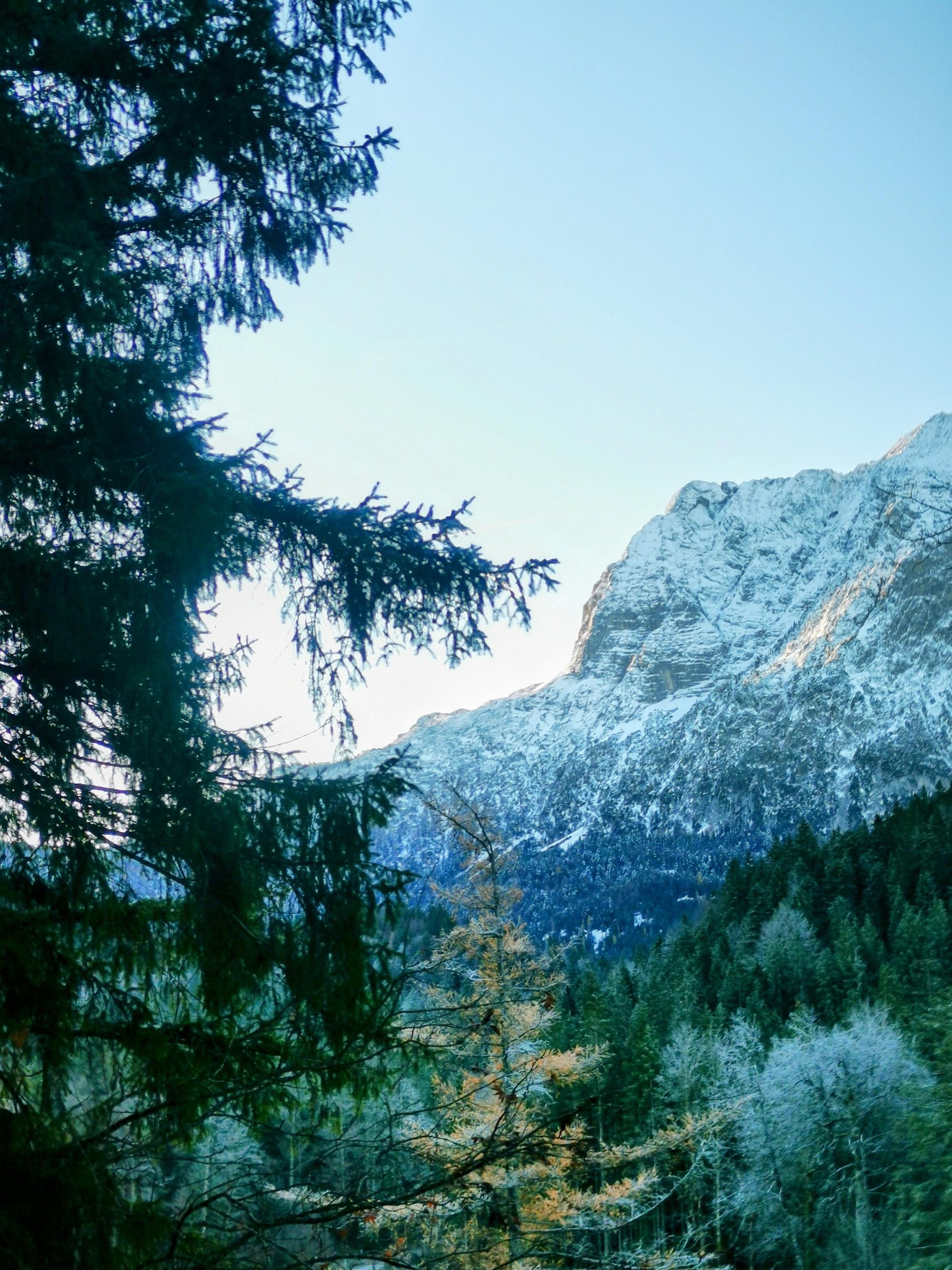
The cold ahead
Through the dark firs, the first white surfaces appear higher up. The season announces itself from a distance before it can be read close at hand.
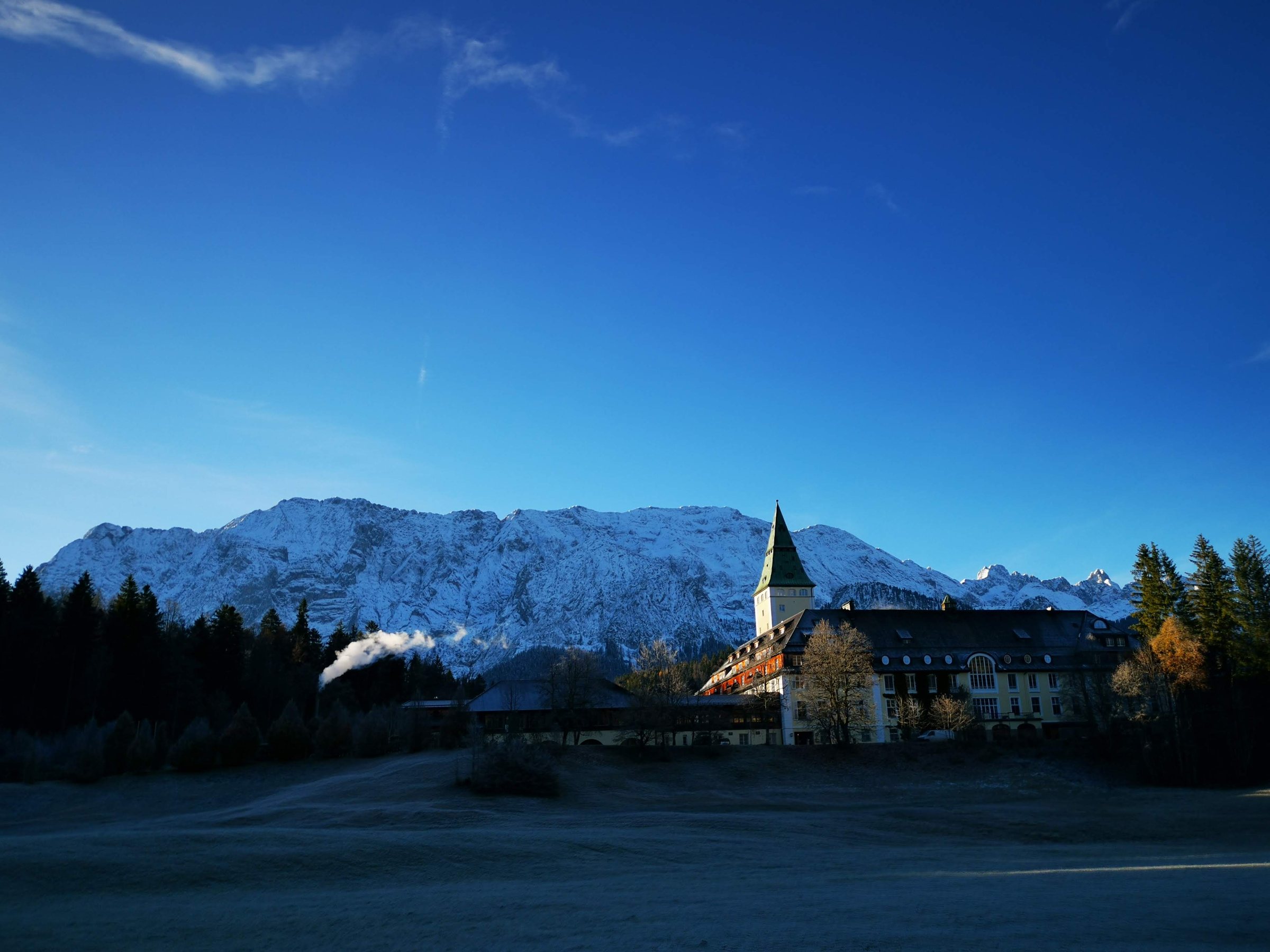
The valley holds it
Schloss Elmau beneath the mountains: frost in the meadow, snow higher above, and autumn still visible between them.
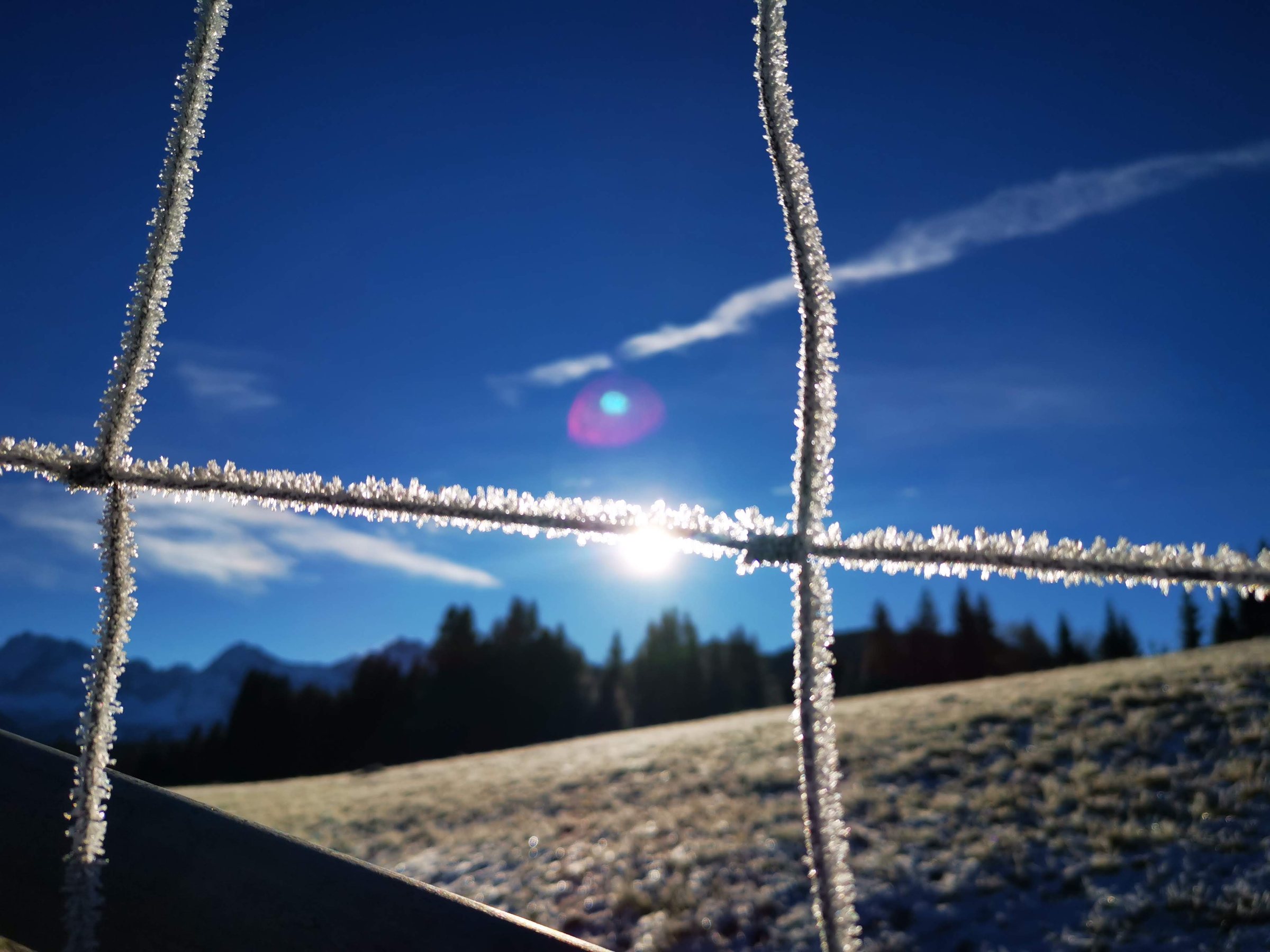
First evidence
Before frost transforms a landscape, it reveals itself along exposed edges — a thin white line catching the morning sun.
The photograph
The flower remains open.
Its pale petals still carry the softness of something living, but every outer edge has been redrawn in white.
Fine frost crystals gather densely around the petals. Smaller crystals spread across their surface and continue onto the stems and buds below.
The morning light changes their appearance again.
What is physically cold begins to glow warm at the edges. Cream, white and pale gold sit beside cooler greens and greys in the background.
That tension is what makes the photograph work for this kō.
It is not an image of winter fully established.
The flower has not disappeared beneath snow. Its shape remains intact.
Instead, the cold has simply touched everything exposed.
The photograph shows winter not as weather, but as texture.
Revisited
First frost is less an event than a boundary.
One morning, autumn is still holding on. By sunrise, every exposed edge can have been redrawn in white.
The mountains make that transition easy to dramatise. Snow on rock is unmistakable. A frozen landscape announces itself from far away.
But the old seasonal observation asks for a closer kind of attention.
霜始降 — the first frost arrives.
Not the first winter.
Not the first snowstorm.
The first frost.
That distinction changes where I look.
Instead of searching only for the grand landscape, attention moves downwards — to the meadow, a wire, a leaf, a flower still open to the morning.
The scale becomes intimate.
And that is where 72 Seasons Revisited becomes most interesting to me.
The old calendar does not simply divide the year more finely.
It continually changes the distance from which the year is observed.
Some seasons ask for the horizon.
Others ask me to move closer.
Season 52 does both.
The mountains announce the cold from afar.
The flower shows where it has actually landed.
The mountains announce it from afar.
A flower receives it at arm’s length.
Winter arrives in miniature.
52 / 72
Another seasonal observation joins the journey.
The year continues, one image at a time.
72 seasons. 72 photographs. One year. One edition.
Notice where you are
What is the first surface to turn white where you are?
A blade of grass.
The edge of a leaf.
A car roof before sunrise.
A thin wire catching the light.
A flower that has not yet finished blooming.
Frost does not need to cover the landscape to change the season.
Sometimes one crystalline edge is enough.