#46 · Sep 23–27 · Autumn Equinox
Thunder falls silent
雷乃収声
Kaminari sunawachi koe o osamu · Thunder falls silent
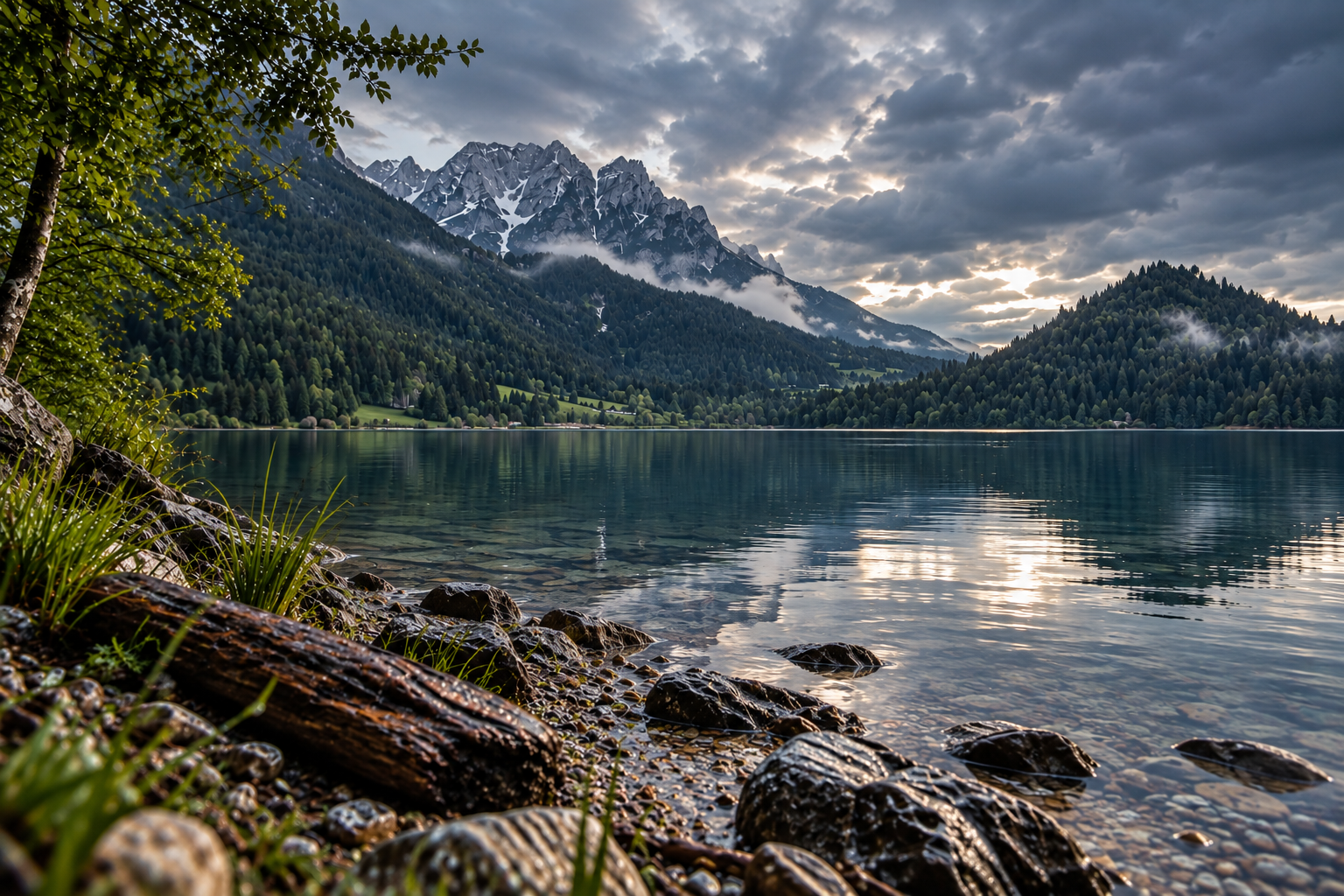
The thunder had passed. The silence stayed behind.
The season
雷乃収声 · Kaminari sunawachi koe o osamu
Thunder falls silent.
The forty-sixth kō belongs to Shūbun — Autumn Equinox, the point in the year when balance shifts and the atmosphere begins to change its register.
This season does not celebrate thunder itself. It notices its withdrawal.
The storms of late summer lose their force. The air clears. The noise recedes. What remains is not spectacle, but aftermath: wet ground, open water, cloud-fragments, and a landscape settling back into itself.
Season 46 marks a subtle turning. The weather has spoken already. Now the year listens to what follows after it.
September 23–27 · Shūbun · Autumn Equinox
Field note · The roadtrip
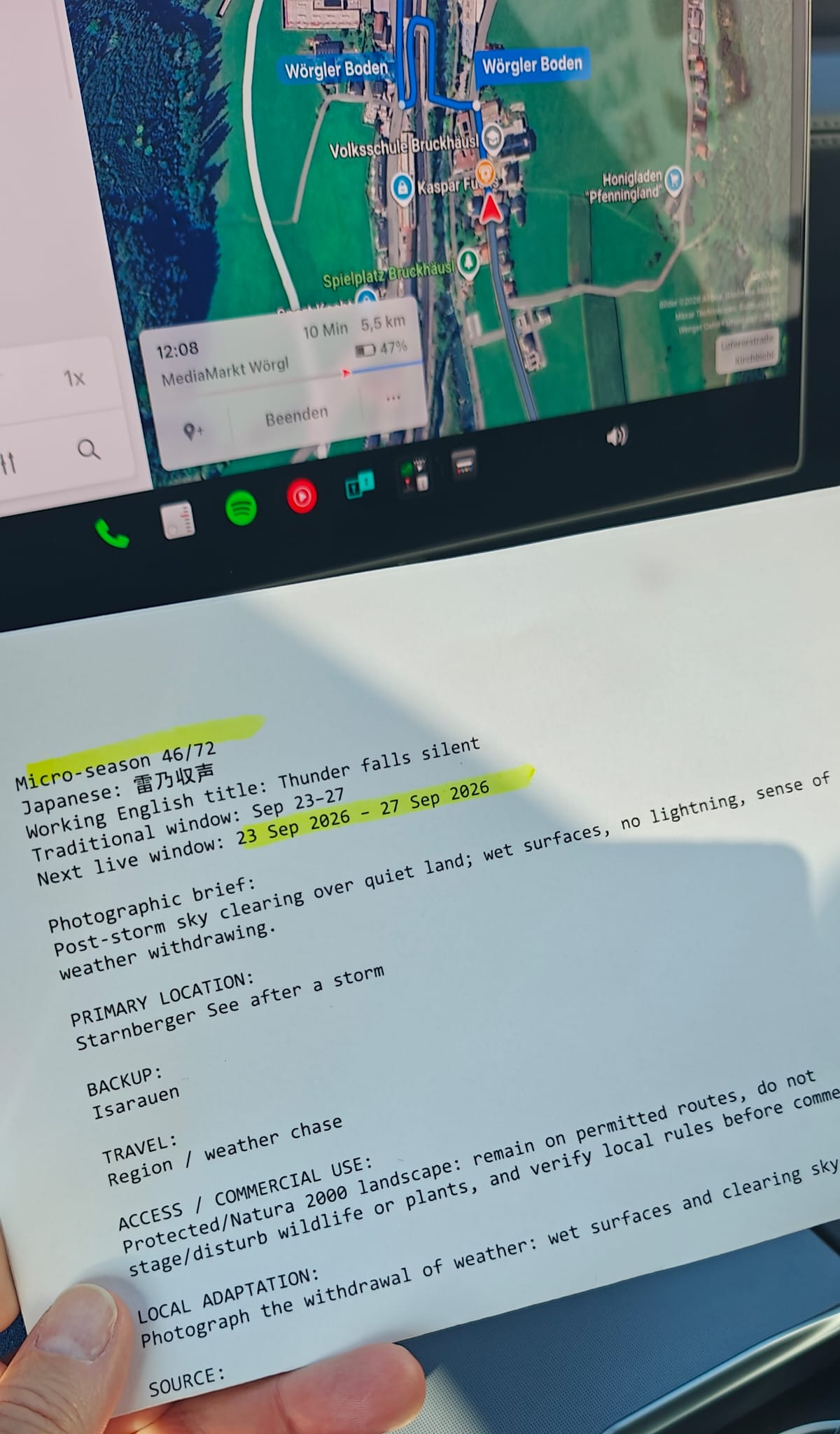
From Starnberger See to Hintersteiner See · September 2026
Season 46 began with a clear plan.
The first idea was Starnberger See — a nearby body of water, familiar enough to be practical, and open enough to hold the mood of weather clearing after a storm.
But once I got there, it became obvious that the season was not there yet.
The weather was almost too good. Too settled. Too clean. Too resolved.
What Season 46 needed was not simply a lake, but the sense of weather withdrawing: wet surfaces, charged air, and a landscape still holding the memory of what had just passed.
So the field trip changed direction.
The drive widened into a longer search and eventually led south to Hintersteiner See in Tyrol.
There, the season finally came together.
Green water. Wet stones. A mountain backdrop with real presence. Clouds still active overhead. A clearer atmosphere, but not a flat one. The drama had not disappeared; it had just moved one step back.
That was the image this kō required. Not thunder itself. Its silence.
The plan
Season 46 began with an idea: Starnberger See, post-storm weather, and the search for a landscape shaped by what had just passed.

The pivot
When the first location did not hold the right atmospheric tension, the journey continued south. Hintersteiner See became the answer.

Small observation
An unexpected encounter in the green water — a reminder that field trips often yield more than the image you came for.
Revisited
The original kō speaks in a few restrained words: thunder ceases. That restraint is part of its force.
Season 46 is not really about the storm. It is about learning to notice what remains once the storm is gone.
That is also what made this field trip unexpectedly precise.
The first location was not wrong. It was simply too finished.
What the season asked for was not clear weather alone, but the transition from unrest to stillness.
At Hintersteiner See, that transition became visible.
The stones were wet. The water held the sky in reflection. The mountains gave the silence weight.
This is what 72 Seasons Revisited tries to test again and again: not whether the original Japanese season can be copied elsewhere, but whether its way of noticing can sharpen the eye in a different landscape.
Here, it did.
The day began as a plan.
It became a search.
It ended in stillness.
46 / 72
Five photographs made.
Sixty-seven observations still ahead.
72 seasons. 72 photographs. One year. One edition.
Notice where you are
How does weather leave a place?
Not with a headline.
Not with a final flash.
Sometimes only through what remains:
darkened stones,
cleared air,
a quieter sky,
and water that suddenly reflects more than it did before.
Some seasons arrive with noise.
Some are only recognisable in the silence after it.